Wednesday, 16 September 2026

Class 12 Class test

 Coordination Compounds – 10 Questions

Define coordination number and ligand with suitable examples.

Identify the coordination number and oxidation state of the central metal ion in �.

Write the IUPAC name of �.

Write the formula of potassium hexacyanidoferrate(II) and determine the oxidation state of iron.

What is meant by monodentate, bidentate and ambidentate ligands? Give one example of each.

Identify the type of ligand and denticity of �, �, and �.

What is ionisation isomerism? Give one suitable example of a coordination compound showing this isomerism.

What type of isomerism is exhibited by � and �? Explain.

Using Valence Bond Theory, explain the hybridisation and magnetic behaviour of �.

Using Crystal Field Theory, explain the splitting of d-orbitals in an octahedral complex with a suitable diagram.

Class 10 Class test

 Class 10 Science – How Do Organisms Reproduce?


20 MCQs 


1. Which mode of reproduction involves only one parent?

A. Sexual reproduction

B. Asexual reproduction

C. Fertilisation

D. Pollination


2. Which of the following organisms reproduces by binary fission?

A. Hydra

B. Amoeba

C. Yeast

D. Planaria


3. Budding is commonly observed in:

A. Amoeba

B. Hydra

C. Plasmodium

D. Leishmania


4. Which structure helps in the vegetative propagation of potato?

A. Root

B. Stem tuber

C. Leaf

D. Flower


5. The process of producing new plants from parts such as roots, stems, or leaves is called:

A. Pollination

B. Fertilisation

C. Vegetative propagation

D. Germination


6. Which part of a flower contains the male reproductive organs?

A. Sepal

B. Petal

C. Stamen

D. Ovary


7. The female reproductive part of a flower is called:

A. Stamen

B. Pistil

C. Anther

D. Filament


8. Where are pollen grains produced in a flower?

A. Stigma

B. Ovary

C. Anther

D. Ovule


9. The transfer of pollen grains from anther to stigma is called:

A. Fertilisation

B. Pollination

C. Germination

D. Reproduction


10. Fertilisation in flowering plants results in the formation of:

A. Pollen grain

B. Zygote

C. Embryo sac

D. Ovary


11. Which organ produces sperm in human males?

A. Penis

B. Testis

C. Prostate gland

D. Vas deferens


12. Which hormone is mainly responsible for the development of secondary sexual characters in boys?

A. Estrogen

B. Progesterone

C. Testosterone

D. Insulin


13. In human females, fertilisation normally takes place in the:

A. Uterus

B. Ovary

C. Fallopian tube

D. Vagina


14. The embryo gets nourishment from the mother through the:

A. Ovary

B. Placenta

C. Cervix

D. Urethra


15. Which hormone is responsible for the release of an egg during ovulation?

A. Insulin

B. LH

C. Thyroxine

D. Testosterone


16. Which of the following is a method of preventing pregnancy?

A. Fertilisation

B. Contraception

C. Ovulation

D. Implantation


17. Which contraceptive method also helps in preventing the transmission of many sexually transmitted infections?

A. Copper-T

B. Oral pills

C. Condom

D. Surgical method


18. Which sexually transmitted disease is caused by a bacterium?

A. HIV/AIDS

B. Gonorrhoea

C. Hepatitis B

D. Genital herpes


19. Why is variation important for the survival of a species?

A. It prevents reproduction

B. It increases the ability to adapt to changing conditions

C. It stops mutations

D. It makes all organisms identical


20. Which type of reproduction produces offspring tha

t are generally genetically similar to the parent?

A. Sexual reproduction

B. Asexual reproduction

C. Cross-pollination

D. Fertilisation


Class 10 Science – How Do Organisms Reproduce?


Answer Key – 20 MCQs


1. B – Asexual reproduction


2. B – Amoeba


3. B – Hydra


4. B – Stem tuber


5. C – Vegetative propagation


6. C – Stamen


7. B – Pistil


8. C – Anther


9. B – Pollination


10. B – Zygote


11. B – Testis


12. C – Testosterone


13. C – Fallopian tube


14. B – Placenta


15. B – LH


16. B – Contraception


17. C – Condom


18. B – Gonorrhoea


19. B – It increases the ability to ada

pt to changing conditions


20. B – Asexual reproduction


Class Test 1 Class 9

 Class 9 Science – Tissues


10 MCQs: Position of Plant Tissues


1. Apical meristem is mainly found at the:

A. Base of leaves

B. Tips of roots and shoots

C. Centre of stem

D. Surface of fruits


2. Intercalary meristem is commonly found:

A. At the tips of roots

B. At the base of leaves or internodes

C. Inside the seed

D. In the bark


3. Lateral meristem is generally present:

A. At the growing tips

B. At the base of leaves

C. Along the sides of stems and roots

D. Inside flowers


4. Collenchyma is mainly found below the epidermis of:

A. Roots only

B. Young stems and leaf stalks

C. Mature fruits only

D. Seeds


5. Sclerenchyma is commonly found in:

A. Coconut husk and seed coats

B. Growing root tips

C. Soft parts of leaves

D. Root hairs


6. Aerenchyma is commonly found in the:

A. Stems and leaves of aquatic plants

B. Root tips of desert plants

C. Bark of old trees

D. Seeds of flowering plants


7. Chlorenchyma is mainly present in:

A. Green parts of plants

B. Root caps

C. Seed coats

D. Woody stems


8. Xylem and phloem are located:

A. Only in the epidermis

B. In vascular bundles

C. Only in root hairs

D. Inside stomata


9. Epidermis is located:

A. In the innermost region of the stem

B. As the outermost protective layer of plant organs

C. Only inside roots

D. Only around vascular bundles


10. Which tissue is found in the growing regions at the tips of roots and shoots?

A. Sclerenchyma

B. Parenchyma

C. Apical meristem


Answer Key – Plant Tissues MCQs


1. B – Tips of roots and shoots


2. B – Base of leaves or internodes


3. C – Along the sides of stems and roots


4. B – Young stems and leaf stalks


5. A – Coconut husk and seed coats


6. A – Stems and leaves of aquatic plants


7. A – Green parts of plants


8. B – In vascular bundles


9. B – Outermost protective layer of plant organs


10. C – Apical meristem


D. Collenchyma

Class Test Class 9 Tissue

 Class 9 Science – Tissues


20 MCQs | No Answers


1. Which tissue is responsible for the growth of plants in length?

A. Permanent tissue

B. Apical meristem

C. Lateral meristem

D. Sclerenchyma


2. Which tissue provides flexibility to plant parts?

A. Sclerenchyma

B. Collenchyma

C. Parenchyma

D. Xylem


3. The cells of meristematic tissue are generally:

A. Dead and thick-walled

B. Large and vacuolated

C. Actively dividing

D. Without a nucleus


4. Which tissue makes the coconut husk hard and tough?

A. Parenchyma

B. Collenchyma

C. Sclerenchyma

D. Phloem


5. Which plant tissue transports water and minerals from roots to other parts?

A. Phloem

B. Xylem

C. Parenchyma

D. Epidermis


6. Which component of xylem is mainly responsible for the upward transport of water?

A. Sieve tubes

B. Vessels

C. Companion cells

D. Phloem fibres


7. Food is transported in plants by:

A. Xylem

B. Phloem

C. Sclerenchyma

D. Collenchyma


8. Which tissue forms the protective outer covering of plants?

A. Epidermis

B. Phloem

C. Meristem

D. Cambium


9. Stomata are mainly involved in:

A. Transport of food

B. Gas exchange and transpiration

C. Absorption of minerals

D. Mechanical support


10. Which simple permanent tissue contains large intercellular spaces?

A. Sclerenchyma

B. Collenchyma

C. Parenchyma

D. Xylem


11. Which animal tissue connects muscles to bones?

A. Ligament

B. Tendon

C. Cartilage

D. Areolar tissue


12. Which tissue connects bone to bone?

A. Tendon

B. Ligament

C. Adipose tissue

D. Blood


13. Which connective tissue stores fat?

A. Areolar tissue

B. Adipose tissue

C. Cartilage

D. Bone


14. Blood is classified as a:

A. Muscular tissue

B. Nervous tissue

C. Connective tissue

D. Epithelial tissue


15. Which epithelial tissue is best suited for absorption in the intestine?

A. Squamous epithelium

B. Cuboidal epithelium

C. Columnar epithelium

D. Ciliated epithelium


16. Which tissue lines the alveoli of lungs?

A. Squamous epithelium

B. Cuboidal epithelium

C. Columnar epithelium

D. Muscular tissue


17. Which muscular tissue is found in the walls of the intestine?

A. Striated muscle

B. Cardiac muscle

C. Smooth muscle

D. Skeletal muscle


18. Cardiac muscles are found in the:

A. Stomach

B. Heart

C. Arms

D. Intestine


19. Which tissue helps in the transmission of nerve impulses?

A. Muscular tissue

B. Epithelial tissue

C. Nervous tissue

D. Connective tissue


20. Which statement about sclerenchyma is correct?

A. Its cells are living and thin-walled

B. Its cells are actively dividing

C. Its cells are dead and have thick, lignified walls

D. It mainly transports food


Class 9 Science – Tissues


Answer Key


1. B – Apical meristem


2. B – Collenchyma


3. C – Actively dividing


4. C – Sclerenchyma


5. B – Xylem


6. B – Vessels


7. B – Phloem


8. A – Epidermis


9. B – Gas exchange and transpiration


10. C – Parenchyma


11. B – Tendon


12. B – Ligament


13. B – Adipose tissue


14. C – Connective tissue


15. C – Columnar epithelium


16. A – Squamous epithelium


17. C – Smooth muscle


18. B – Heart


19. C – Nervous tissue


20. C – Its cells are dead and have thick, lignified walls


 Class 12 Chemistry – Coordination Compounds


Quick Revision Notes


1. Basic Terms


Coordination compound: A compound in which a 

central metal atom/ion is surrounded by ions or molecules 

called ligands, which donate electron pairs to the metal.


Example:


\[

[Co(NH_3)_6]Cl_3

\]


Central metal ion → Co³⁺


Ligand → NH₃


Coordination number → 6


Coordination sphere → [Co(NH₃)₆]³⁺


Counter ions → 3Cl⁻


2. Important Definitions


Term Meaning


Ligand Ion/molecule that donates an 

electron pair to metal

Coordination number Number of donor atoms

 directly attached to central metal

Coordination sphere Species written inside

 square brackets

Oxidation state Charge on metal after considering

 ligand charges

Denticity Number of donor atoms of a ligand attached

 to metal

Chelate Ring formed when a multidentate ligand 

attaches to metal


3. Types of Ligands


According to denticity:


Monodentate: One donor atom

Examples: NH₃, H₂O, Cl⁻, CN⁻


Bidentate: Two donor atoms

Examples: en (ethane-1,2-diamine), \(C_2O_4^{2-}\)


Polydentate: More than two donor atoms

Example: EDTA⁴⁻


Ambidentate ligands: Can coordinate through two different atoms.


Examples:


\(NO_2^-\) → nitro / nitrito


\(SCN^-\) → thiocyanato / isothiocyanato


4. Werner's Theory


Werner proposed two types of valencies:


Primary valency


Corresponds to oxidation state.


Ionisable.


Satisfied by negative ions.


Secondary valency


Corresponds to coordination number.


Non-ionisable.


Satisfied by ligands.


Example:


[Co(NH_3)_6]Cl_3


Primary valency = 3

Secondary valency = 6


5. Coordination Number


Coordination number = Number of donor atoms directly

 bonded to the central metal ion.


Examples:


[Co(NH_3)_6]^{3+}


CN = 6


[PtCl_4]^{2-}


CN = 4


For:


[Co(en)_3]^{3+}


Each en is bidentate.


CN = 3times2=6


6. Oxidation State


Use:

Oxidation state of metal}+charges of ligands

=charge on complex


Example:


\[

[Fe(CN)_6]^{4-}

\]


Let oxidation state of Fe = x.


\[

x+6(-1)=-4

\]


\[

x=+2

\]


Therefore, Fe = +2.


---


7. Nomenclature


Basic order:


Ligands + metal + oxidation state


Important ligand names:


NH₃ → ammine


H₂O → aqua


CO → carbonyl


NO → nitrosyl


Cl⁻ → chlorido


Br⁻ → bromido


OH⁻ → hydroxido


CN⁻ → cyanido


\(C_2O_4^{2-}\) → oxalato


Prefixes:


2 → di


3 → tri


4 → tetra


5 → penta


6 → hexa


Example:


\[

[Co(NH_3)_6]Cl_3

\]


Hexaamminecobalt(III) chloride


For an anionic complex, metal name ends in -ate.


\[

K_4[Fe(CN)_6]

\]


Potassium hexacyanidoferrate(II)


---


8. Isomerism


Coordination compounds show:


A. Structural isomerism


1. Ionisation isomerism


2. Hydrate/Solvate isomerism


3. Linkage isomerism


4. Coordination isomerism


B. Stereoisomerism


1. Geometrical isomerism


cis


trans


2. Optical isomerism


Non-superimposable mirror images


Called enantiomers


Example:


\[

[Pt(NH_3)_2Cl_2]

\]


shows cis-trans isomerism.


---


9. Valence Bond Theory (VBT)


VBT explains:


Hybridisation


Geometry


Magnetic nature


Common hybridisations:


Hybridisation Geometry


\(sp^3\) Tetrahedral

\(dsp^2\) Square planar

\(sp^3d^2\) Octahedral – outer orbital

\(d^2sp^3\) Octahedral – inner orbital


---


10. Strong and Weak Ligands


Weak-field ligands generally do not cause pairing.


Examples:


\[

F^-, Cl^-, Br^-, I^-, H_2O

\]


Strong-field ligands cause pairing of electrons.


Examples:


\[

CN^-, CO, NH_3

\]


A useful simplified spectrochemical series:


\[

I^-<Br^-<Cl^-<F^-<H_2O<NH_3<CN^-<CO

\]


---


11. Inner and Outer Orbital Complexes


Inner orbital complex:


Uses \((n-1)d\) orbitals.


Example:


\[

d^2sp^3

\]


Outer orbital complex:


Uses \(nd\) orbitals.


Example:


\[

sp^3d^2

\]


---


12. Crystal Field Theory (CFT)


According to CFT, ligands approach the metal ion and cause splitting of d-orbitals.


Octahedral complex


Five d-orbitals split into:


Lower energy → \(t_{2g}\)


Higher energy → \(e_g\)


Energy gap = \(\Delta_o\)


Tetrahedral complex


Lower energy → \(e\)


Higher energy → \(t_2\)


Energy gap = \(\Delta_t\)


\[

\Delta_t \approx \frac{4}{9}\Delta_o

\]


---


13. Magnetic Properties


Paramagnetic: Has one or more unpaired electrons.


Diamagnetic: All electrons are paired.


Magnetic moment:


\[

\boxed{\mu=\sqrt{n(n+2)}\ BM}

\]


where n = number of unpaired electrons.


Examples:


n = 0 → 0 BM

n = 1 → 1.73 BM

n = 2 → 2.83 BM

n = 3 → 3.87 BM

n = 4 → 4.90 BM

n = 5 → 5.92 BM


---


14. Colour of Coordination Compounds


Colour is generally due to d–d transitions.


When an electron absorbs energy, it moves from a lower-energy d-orbital to a higher-energy d-orbital.


The absorbed wavelength determines the colour observed.


Important: \(d^0\) and \(d^{10}\) complexes generally do not show d–d transitions.


---


15. Stability of Coordination Compounds


Stability is related to the formation/stability constant.


For:


\[

M+4L\rightleftharpoons ML_4

\]


\[

K_f=\frac{[ML_4]}{[M][L]^4}

\]


Higher \(K_f\) generally means greater stability.


---


16. Chelate Effect


Complexes containing multidentate ligands are generally more stable than comparable complexes containing monodentate ligands.


Example:


\[

[Ni(en)_3]^{2+}

\]


is a chelate complex.


Reason: Formation of stable rings and favourable entropy change.


---


17. Applications


Coordination compounds are important in:


Biological systems: Haemoglobin, chlorophyll, vitamin B₁₂


Medicine: Cisplatin


Metallurgy: Extraction of metals


Qualitative analysis: Detection/separation of metal ions


Photography: Silver complexes


Electroplating: Metal complexes


---


⭐ Must-Remember for Exams


1. Ox

idation state ≠ coordination number.


2. Denticity counts donor atoms, not ligands.


3. Strong-field ligands → pairing → often low spin.


4. Weak-field ligands → less pairing → often high spin.


5. \(\boxed{\mu=\sqrt{n(n+2)}\ BM}\)


6. Octahedral: \(\boxed{t_{2g}<e_g}\)


7. Tetrahedral: \(\boxed{e<t_2}\)


8. \(\boxed{\Delta_t=\frac49\Delta_o}\)


9. Anionic complex → metal name generally ends in -ate.


10. Chelating ligands form rings with the central metal ion.


Tuesday, 15 September 2026

Class test 10


Class 10 Physics – Electricity

HOTS Questions – Without Answers

  1. A 1.5 kW electric heater is used for 4 hours daily. If electricity costs ₹7 per unit, calculate the electrical energy consumed and the cost of electricity for 30 days.

  2. A family uses a 1000 W electric heater for 3 hours and a 200 W fan for 8 hours every day. Calculate the total electrical energy consumed in one day and the electricity bill for 30 days at ₹7 per unit.

  3. An electric iron rated 220 V, 1100 W is used for 2 hours daily. Calculate the current drawn by the iron and the electrical energy consumed in 15 days.

  4. Two appliances rated 1000 W and 500 W are connected to the same household supply. The first is used for 2 hours and the second for 6 hours daily. Which appliance consumes more electrical energy in a week? Calculate the difference.

  5. A 2 kW heater and a 60 W fan are used simultaneously for 3 hours. If the cost of electricity is ₹8 per unit, calculate the total cost of electricity. What would happen to the cost if the heater were used for only 2 hours?

  6. An electrical appliance consumes 4.5 units of electricity in 3 hours. Calculate its power rating in watts. If it is used for 5 hours daily, calculate its energy consumption in 10 days.

Class Test 9


Class 9 Science – Tissues

Class Test – 10 Questions

  1. What is a tissue? Why are tissues important in multicellular organisms?

  2. Name the different types of plant tissues.

  3. What is the main function of meristematic tissue?

  4. Differentiate between apical meristem and lateral meristem.

  5. What are the functions of parenchyma, collenchyma and sclerenchyma?

  6. What is the function of xylem and phloem?

  7. Name the four main types of animal tissues.

  8. Differentiate between squamous epithelium and cuboidal epithelium.

  9. What is the function of connective tissue? Give two examples.

  10. Differentiate between striated, unstriated and cardiac muscles.

Friday, 11 September 2026

Class Test Electricity


Questions


1. Two resistors of 4 Ξ© and 6 Ξ© are connected in

 series to a 20 V battery. Calculate:

(a) Equivalent resistance

(b) Current through the circuit

(c) Potential difference across each resistor.


2. Three resistors of 2 Ξ©, 3 Ξ© and 5 Ξ© are connected 

in series with a 20 V supply. Find the total resistance,

 current and power consumed by the circuit.


3. Two resistors of 6 Ξ© and 3 Ξ© are connected in

 parallel across a 12 V battery. Calculate:

(a) Equivalent resistance

(b) Current through each resistor

(c) Total current supplied by the battery.


5. A heater has a resistance of 20 Ξ© and is connected 

to a 220 V supply. Calculate:

(a) Current through the heater

(b) Power consumed

(c) Energy consumed in 2 hours.


6. Two resistors of 10 Ξ© and 20 Ξ© are connected in

 series to a 60 V source. A student claims that both 

resistors will consume equal power. Is the claim

 correct? Calculate the power consumed by each

 resistor.


7. Two appliances of 60 W and 100 W, both rated at

 220 V, are connected in parallel to a 220 V supply.

 Calculate the current drawn by each appliance and

 the total current.


8. A 1.5 kW electric heater is used for 4 hours.

 If electricity costs ₹7 per unit, calculate:

(a) Electrical energy consumed

(b) Cost of electricity.


9. A circuit contains three resistors of 3 Ξ© each.

 They are first connected in series and then in

 parallel across the same 18 V battery. Compare:

(a) Equivalent resistance

(b) Total current

(c) Total power consumed in both arrangements.


Case Base study


Case Study 1: Pushing a Trolley


A student pushes an empty shopping trolley with

 a certain force. The trolley starts moving and its 

speed increases. When the same force is applied 

to a loaded trolley, the trolley accelerates more 

slowly. When the student stops pushing, the trolley 

gradually comes to rest due to friction.


Questions:


1. Why does the trolley start moving when the student

 pushes it?


2. What happens to the acceleration when the mass of the

 trolley is increased while the applied force remains the same?


3. Which force brings the trolley to rest after the student 

stops pushing?


4. According to Newton’s second law, write the relation 

between force, mass and acceleration.


Answers:


1. An unbalanced force acts on the trolley.


2. Acceleration decreases.


3. Frictional force.


4. F = ma


Case Study 2: Football Game


During a football match, a stationary football is kicked

 by a player. The ball starts moving rapidly. Another player 

stops the moving ball by applying force with his foot. 

Sometimes, a player changes the direction of a moving 

ball by kicking it from the side.


Questions:


1. What effect of force is demonstrated when the stationary ball starts moving?


2. What happens to the motion of the ball when the second player stops it?


3. How can force change the direction of a moving object?


4. Is force required to change the velocity of an object?


Answers:


1. Force changes the state of rest of the ball.


2. Its velocity decreases and becomes zero.


3. By applying force in a direction different from its existing motion.


4. Yes. A change in velocity requires an unbalanced force.


---


Case Study 3: Bus Starting Suddenly


A passenger is standing inside a bus. When the driver suddenly

 starts the bus, the passenger tends to fall backwards. When the

 moving bus suddenly applies brakes, the passenger tends to move forward.


Questions:


1. Why does the passenger fall backwards when the bus starts suddenly?


2. Why does the passenger move forward when the moving bus stops suddenly?


3. Which property of matter is responsible for this behaviour?


4. State the law of motion associated with this phenomenon.


Answers:


1. Due to inertia, the passenger's body tends to remain at rest while the bus moves forward.


2. Due to inertia, the body tends to continue its state of motion.


3. Inertia.


4. Newton’s First Law of Motion.


---


Case Study 4: Cricket Ball


A cricket ball of mass 0.2 kg is initially at rest. A batsman

 applies a force of 10 N on the ball for a short time. The force makes the ball move forward.


Questions:


1. Calculate the acceleration produced in the ball.


2. What would happen to the acceleration if the same force were applied to a ball of greater mass?


3. What type of force changes the state of motion of the ball?


4. Which Newton’s law gives the mathematical relationship between force, mass and acceleration?


Answers:


1. Using F = ma


\[

   a=\frac{F}{m}=\frac{10}{0.2}=50\,m/s^2

\]


2. Acceleration would decrease.


3. Unbalanced force.


4. Newton’s Second Law of Motion.


---


Case Study 5: Rocket Launch


A rocket is launched from the Earth. Hot gases are expelled downward at very high speed. As a result, the rocket moves upward. The upward motion of the rocket occurs even though there is no solid surface for the rocket to push against.


Questions:


1. Which Newton’s law explains the upward motion of the rocket?


2. What is the action force in this situation?


3. What is the reaction force?


4. Are the action and reaction forces equal in magnitude?


5. Do action and reaction forces act on the same object?


Answers:


1. Newton’s Third Law of Motion.


2. The rocket exerts a force on 

the gases downward.


3. The gases exert an upward force on the rocket.


4. Yes, they are equal in magnitude and opposite in direction.


5. No. They act on two different objects.


Monday, 7 September 2026

How Forces Affect Motion Class 9 NCERT Solutions

 How Forces Affect Motion Class 9 NCERT Solutions

1. Why does a canoe move forward when the canoeist pushes water backwards with their paddle, and why does it move faster when they push harder?

Answer: When the canoeist pushes water backwards with the paddle, then the water pushes the canoe forward. This happens because of Newton’s 3rd Law, which states that “every action has an equal and opposite reaction”. If the canoeist pushes the water harder, then the force on the water will be big. A bigger force on water means a bigger reaction force on the canoe, and because of this, the canoe moves faster.

2. Suppose the same canoeist uses the same paddle force in two different canoes, one empty and one carrying another passenger. In which case will the canoe move faster?

Answer: If canoe is empty or full with passengers, in both cases acceleration depends on force ÷ mass which is Newto’s 2nd law.

  • In an empty canoe, the acceleration is bigger, so the canoe moves fast.
  • In a canoe with a passenger, the acceleration is smaller, so the canoe moves slower.

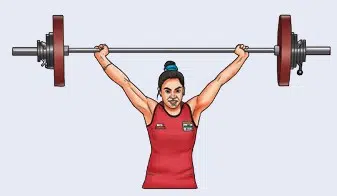
3. A weightlifter lifts a barbell (Fig. 6.8). List two forces that are acting on the barbell. Are these forces balanced if the weightlifter keeps the barbell steady?

How Forces Affect Motion Class 9 Fig 1

Answer: The two forces that are acting on the barbell are

  • Gravitational force. The gravitational force pulls the barbell downward with a force equal to its weight.
  • Upward force: The weightlifter’s hands apply an upward force to hold the barbell.

Yes, the weightlifter keeps the barbell steady, meaning not moving up or down; here, upward force equals to the downward gravitational force. It is known as a balanced force.

Computer Science Notes

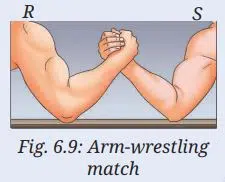
4. Two players R and S are participating in an arm-wrestling match (Fig. 6.9). At the instant, when the arms tilt to the front direction (out of the page towards you), are the forces exerted by the players balanced? If not, which player exerted the larger force?
How Forces Affect Motion Class 9 Fig 2

Answer: In arm wrestling, the two players push against each other with equal force than the arm stays in the middle. This is called a balanced force, but if one pushes stronger, then the arm moves. Then the forces are unbalanced.

CBSE Syllabus Updates


5. The force of friction disappears in the world? How will the motion of objects be impacted?

Answer: If the friction disappears, then the object will not stop on its own and will keep moving once started. Without friction people cannot walk or drive because there is no grip. Motion will become uncontrolled, and everything keeps sliding until blocked.

Learn Quantum Physics

6. An object is moving with a constant velocity. Is there a net force acting upon it?

Answer: Newton’s 1st law says that “an object keeps moving with constant velocity unless a net force acts on it”. So, if an object is moving with constant velocity, there is no net force acting on it, and then the net force will be 0.


7. Suppose, no net force is acting on an object. Which of the following situations are possible?
(i) Object remains at rest if at rest.
(ii) Object keeps moving with a constant velocity if already moving.
(iii) Object is moving with a constant acceleration.

Answer: The situations which are possible are –

  • (i) Object remains at rest if at rest: Yes, it is possible because, if the object was already at rest, it will continue to stay at rest.
  • (ii) Object keeps moving with a constant velocity if already moving.: Yes, it is possible, if the object is already moving then it will keep moving at the same speed and in the same direction.
  • (iii) Object is moving with a constant acceleration: This is not possible, because acceleration requires a net force.

8. In the real world, it is difficult to find a situation where no forces are acting on an object. But by applying additional forces, a condition can be achieved where the net force on the object is zero. Explain with the help of an example.


Answer: In the real world, it is very hard to find an object with no forces at all acting on it. But sometimes, by applying some additional forces, we can make the net force = 0. For example, A book kept on a table table where downword gravitational force is applied. The table applies an equal upward force. These two forces are equal and opposite, so they cancel each other, and the book remains at rest.

Learn Quantum Physics

9. How much does a force of 1 N feel? If you hold a 100 g mass in your palm, the upward force your palm applies on the mass is around 1 N.

Answer: If you hold a 100 g object like small apple, chocolate bar or biscuit packet in your hand, you palm pushes upward force with 1 N to stop from falling. So, the feel of 1 N is just like holding a light object in your hand.

10. A toy car of mass 100 g is moving with a constant velocity of 0.5 m s–1. What is the net force acting on the toy car?

Answer:

  • Mass of toy car = 100 g = 0.1 kg
  • Velocity = 0/5 m/s (constant)

If velocity is constant, the car is not accelerating.

Newton’s 2nd Law: F = m . a

  • 𝐹 = force
  • π‘š = mass
  • π‘Ž = acceleration

Here, acceleration is a = 0

  • F = 0.1 x 0
  • = 0 N

The net force acting on the toy car is 0 N.

11. Two children of different masses are sitting on identical swings. To impart identical initial acceleration, for which child would you require to apply a larger force? Explain why.

Learn Quantum Physics

Answer: To impart the same initial acceleration, you must apply a larger force on the child with greater mass. This is because force depends on mass ( 𝐹 = π‘š ⋅ π‘Ž ).

12. How are glass items packed for transportation using a bubble wrap or hay protected from damage?

Answer: The glass item are packed with bubble wrap or hay because these materials act as shock absorbers. They helps to reduce vibration and prevent direct impact, so the glass does not break during transportation.

13. Why does a fireperson sometimes struggle when holding the pipe issuing water?

Answer: A fireperson struggles to hold the pipe because the fast water coming out produces a backward reaction force on the pipe. This force push the pipe back and fireperson apply effort to control the pipe.

14. Suppose a spacecraft is moving in a region of space where the gravitational force acting upon it is negligible. Suggest how can it change its velocity.

Answer: In space there is no gravety when the rockets are fired they push gas backward. As per the Newton’s 3rd law, Gas goes backward and spacecraft goes forward.

16. Using a horizontal force F, a table is moved across the floor at a constant velocity. How much is the frictional force exerted by the floor on the table?

Answer: A table is moved across the floor with a horizontal force F. It moves at constant velocity, the constant velocity means no acceleration. Newton’s 2nd Law says:

𝐹net = π‘š ⋅ π‘Ž

  • Here, a = 0
  • So the net force = 0

It means the forward force (F) is exactly balanced by the frictional force.

18. For a ball moving on a smooth frictionless surface, choose the appropriate option that will make the following statements physically correct.
(i) If no net force is applied on the ball, the velocity of the ball will remain the same/increase/decrease.
(ii) If a net force is applied on the ball in the direction of its motion, the magnitude of the velocity of the ball will remain the same/ increase/decrease.
(iii) If a net force is applied on the ball in a direction opposite to the direction of its motion, the magnitude of the velocity of the ball will remain the same/increase/decrease.

Answer:

(i) If no net force is applied on the ball, the velocity of the ball will remain the same/increase/decrease.

Learn Quantum Physics

Answer: The velocity will remain the same.

(ii) If a net force is applied on the ball in the direction of its motion, the magnitude of the velocity of the ball will remain the same/ increase/decrease.

Answer: The velocity will increase.

(iii) If a net force is applied on the ball in a direction opposite to the direction of its motion, the magnitude of the velocity of the ball will remain the same/increase/decrease.

Answer: The velocity will decrease.

19. Two blocks P and Q on a smooth horizontal surface are shown in Fig. 6.36a and Fig. 6.36b. Two forces of magnitudes 4 N and 5 N are acting in opposite directions on block P, while block Q is moving with a constant velocity.
Which of the following statement is correct?
(i) P experiences a net force and Q does not experience a net force.
(ii) P does not experience a net force and Q experiences a net force.
(iii) Both P and Q experience a net force.
(iv) Neither P nor Q experiences a net force.

Answer: (i) P experiences a net force and Q does not experience a net force.

Explanation:

For Block P

  • The Net Force = 5N – 4N = 1N
  • So the P will experience a net force.

For Block Q

  • The constant velocity means there will no acceleration.
  • Net Force = 0

So, Q do not experience a net force.

20. While practising for the snake boat race (Vallum kalli in Kerala), 100 oarsmen are rowing a boat together. Out of these, 95 row backwards to propel the boat forward. But by mistake, 5 oarsmen row in the opposite direction. If each oarsman applies a horizontal force of 200 N, what is the net force on the snake boat? (Ignore drag forces, air friction, etc.)

Answer: The net force on the snake boat will be 18,000 N forward.

Explanation:

Situation given,

  • Total oarsmen: 100
  • 95 row backwards: boat moves forward.
  • 5 row forward (wrong way): boat gets backward push.
  • Each oarsman applies 200 N force.
  • Learn Quantum Physics

The Calculation,

Force by 95 oarsmen = 95 × 200 = 19,000 N (forward).

Force by 5 oarsmen = 5 × 200 = 1,000 N (backward).

Net force = Forward force – Backward force

19,000 − 1,000 = 18,000 N

21. When a net force acts on an object, we observe that the object accelerates: 
(i) opposite to the direction of force, with acceleration proportional to the force acting on the object.
(ii) opposite to the direction of force, with acceleration proportional to the mass of the object.
(iii) in the direction of force, with acceleration inversely proportional to the force acting on the object.
(iv) in the direction of force, with acceleration proportional to the force acting on the object.

Answer: (iv) in the direction of force, with acceleration proportional to the force acting on the object.

Explanation:

The Newton’s 2nd Law

F = m . a

  • Force and acceleration are directly linked together.
  • Acceleration is always in the same direction as the force.
  • Bigger force means bigger acceleration.

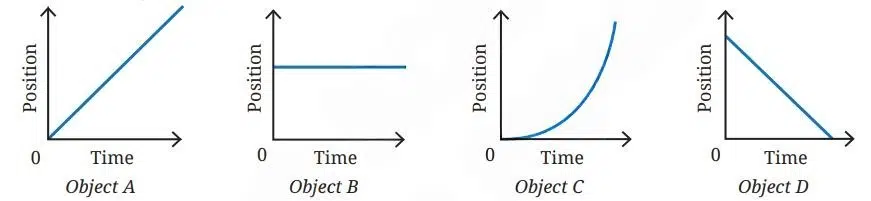
22. The position-time graph for four objects A, B, C and D moving along a straight line are given in Fig. A net force acts on:
(i) Object A
(ii) Object B
(iii) Object C
(iv) Object D

How Forces Affect Motion Class 9 Fig 3

Answer: From the position-time graphs of objects A, B, C, and D:

  • In Object A, the graph is a straight line going upward. This means the object is moving with constant speed. Therefore, no net force acts on Object A.
  • In Object B, the graph is a horizontal line. This means the object is not moving and remains at rest. Therefore, no net force acts on Object B.
  • In Object C, the graph is a straight line going downward. This means the object is speeding up, or accelerating. Therefore, a net force acts on Object C.
  • In Object D, the graph is a straight line going downward. This means the object is moving with constant speed in the opposite direction. Therefore, no net force acts on Object D.
  • Learn Quantum Physics

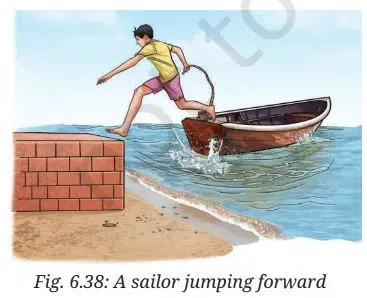
23. A sailor jumps out from a small boat to the shore (Fig. 6.38). As the sailor jumps forward, will the boat move? If yes, in which direction and why.

How Forces Affect Motion Class 9 Fig 4

Answer: Yes, the boat will move when the sailor jumps forward to the shore; he pushes the boat backward. This happens because of Newton’s third law of motion, “Every action has an equal and opposite reaction.”

  • Action: The sailor pushes the boat backward while jumping forward.
  • Reaction: The boat moves backward in the opposite direction.

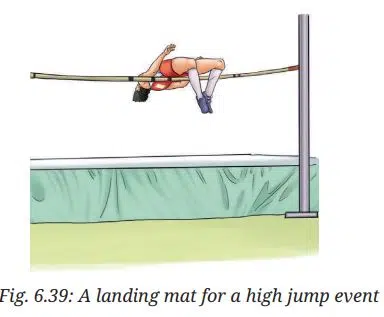
24. During a high jump event, a landing mat or sand bed is placed for the athlete to fall upon (Fig. 6.39). Explain the reason behind it.

How Forces Affect Motion Class 9 Fig 5

Answer: In a high jump, a soft mat or sand bed is used so the athlete stops slowly after falling. This increases stopping time, reduces the force on the body, and prevents injury.

25. A hand cart loaded with vegetables collides with an identical but empty hand cart. During the collision:
(i) the loaded cart exerts a force of larger magnitude on the empty cart.
(ii) the empty cart exerts a force of larger magnitude on the loaded cart.
(iii) neither cart exerts a force on the other.
(iv) the loaded cart and the empty cart, both exert an equal magnitude of force on each other.

Answer: (iv) the loaded cart and the empty cart, both exert an equal magnitude of force on each other.

Explanation:

As per the Newton’s 3rd Law, When two objects push each other, the force are equal in size but oppooite in direction. So,

Learn Quantum Physics

  • Loaded cart pushes empty cart.
  • Empty cart pushes loaded cart
  • Both force are equal.

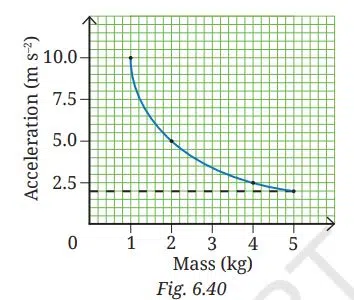
26. The acceleration-mass graph for the acceleration produced by a force on objects of different masses is plotted in Fig. 6.40. Plot the force-mass graph for this case.

How Forces Affect Motion Class 9 Fig 6

Answer: The graph shows acceleration versus mass. It tells us that when mass increases, acceleration decreases, if the force is the same. If we plot force versus mass:

From Newton’s Second Law:

F = m x a

In this case, the applied force is constant. This means, no matter what the mass is, the force value does not change.

So, the force-mass graph will be a straight horizontal line, which shows that the force remains the same for all values of mass.

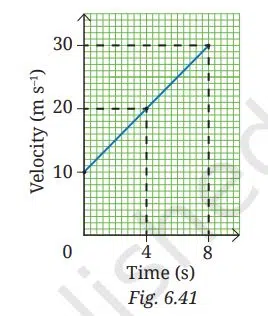
27. The velocity-time graph of an object of mass 10 kg moving along a straight line is shown in Fig. 6.41. Calculate the force acting on the object by using the graph.

How Forces Affect Motion Class 9 Fig 7

Answer: The time graph of an object of mass 10 kg.

  • In graph, initial velocity: At time t = 0, velocity = 10 m/s
  • In graph, final velocity: At time t = 8 seconds, velocity = 30 m/s

Find acceleration:

So, acceleration = 2.5 m/s².

Apply Newton’s Second Law:

F = m x a = 10 x 2.5 = 25 N

The force acting on the object is 25 Newton.

Learn Quantum Physics

28. A bullet of mass 50 g moving with a speed of 100 m s–1 enters a heavy stationary wooden block and stops after penetrating a distance of 50 cm. Estimate the stopping force acting on the bullet (assume that the bullet undergoes constant acceleration within the block).

Answer: The stopping force on the bullet = 500 N (opposite to motion).

Explanation:

Given

  • Mass of bullet = 50 g = 0.05 kg
  • Speed of bullet = 100 m/s
  • Distance penetrated = 50 cm = 0.5 m
  • Bullet stops -> final velocity = 0

Use equation of motion

  • v2 = u2 + 2as

Here:

  • v = 0 (final velocity)
  • u = 100 m/s (initial velocity)
  • s = 0.5 m
  • 0 = ( 100 )2 + 2.a.0.5
  • 0 = 10000 + a
  • a = −10000 m/s2

Negative sign means deceleration.

  • F = m . a
  • F = 0.05 × 10000
  • = 500 N

29. An ace footballer converted a penalty shot by kicking the football with a speed of 108 km h–1. The estimated force they imparted was 800 N. The mass of the football was 0.4 kg. Calculate the time of contact between their foot and the ball.

Answer: The time of contact between their foot and the ball is 0.015 seconds

Given

  • Speed of football = 108 km/h
  • Mass of football = 0.4 kg
  • Force applied = 800 N

Convert speed to m/s

So, ball speed = 30 m/s.

  • Use the impulse formula.
  • Impulse = Change in momentum = Force × Time

F.t = m.v

Here:

  • F = 800 N
  • m = 0.4 kg
  • v = 30 m/s

30. An object of mass 2 kg moving with a constant velocity of 10 m s–1 encounters a rough patch where the force of friction on the object is 7 N. At the same time, an additional constant force of 3 N opposing the motion is applied on the object. After entering the rough patch, how much distance does the object travel before coming to rest?

Answer: The object travels 10 metres before coming to rest.

Given

  • Mass of object = 2 kg
  • Initial velocity = 10 m/s
  • Friction force = 7 N
  • Extra opposing force = 3 N
  • Final velocity = 0 (object stops)

Net opposing force

  • Fnet = 7 + 3 = 10 N

Acceleration (deceleration)

  • F = m . a
  • 10 = 2 . a
  • a = 5m/s2

Use equation of motion

  • v2 = u2 + 2as

Here:

  • v = 0
  • u = 10
  • a = -5
  • 0 = (10)2 + 2 . (-5) . s
  • 0 = 100 – 10s
  • 10s = 100
  • s = 10m

30. A tractor pulls a harrow (a ploughing tool) of mass m1 with a net force F resulting in an acceleration of a1 . The same tractor pulls a trolley of mass m2 with a force F producing an acceleration of a2. If the tractor Fig. 6.42: A bar magnet and a magnetic compass now pulls the trolley with the harrow placed on it (with the same force F ), then obtain an expression for the resulting acceleration in terms of a1 and a2 . Ignore friction.

Learn Quantum Physics

How Forces Affect Motion Class 9 Fig 8

Answer:

Situation given,

  • Tractor pulls harrow: acceleration a1.
  • Tractor pulls trolley: acceleration a2.
  • Same force F is used in both cases.
  • Now tractor pulls harrow and trolley together.

For harrow:

For trolley:

Together:

Acceleration when combined:

Simplify

The acceleration of harrow and trolley together is:

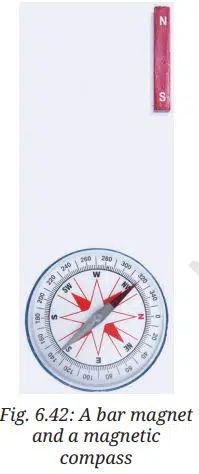
32. When the pole of a bar magnet is brought close to a magnetic compass, the bar magnet and the compass needle (which is also a magnet) exert a magnetic force on each other. As per Newton’s third law of motion, both the forces are equal in magnitude and opposite in direction. However, the compass needle moves, whereas the bar magnet does not move (Fig. 6.42). Explain why.

How Forces Affect Motion Class 9 Fig 8

Answer: When the pole of a bar magnet is brought near a compass, both the magnet and the compass needle pull on each other with equal force.

But the compass needle moves and the bar magnet does not. The reason is simple:

  • The compass needle is small and light. It is free to rotate, so even a small force makes it move.
  • The bar magnet is big and heavy. It is fixed in place, so the same force cannot move it.