
Batteries
Quick Notes
- Batteries are devices consisting of one or more galvanic cells used to generate electrical energy.
- Primary batteries: Non-rechargeable; used once (e.g. dry cell).
- Secondary batteries: Rechargeable; can be reused multiple times (e.g. lead storage battery).
Full Notes
A battery is essentially a device that converts chemical energy into electrical energy through redox reactions.
It consists of one or more electrochemical cells connected in series or parallel. Batteries are broadly classified into two types: primary (non-rechargeable) and secondary (rechargeable).
Primary Batteries
Primary batteries are designed for single-use applications. Once the chemical reaction completes and all reactants are used up, they cannot be recharged. The most familiar example is the dry cell.
Dry Cell (Leclanché Cell)
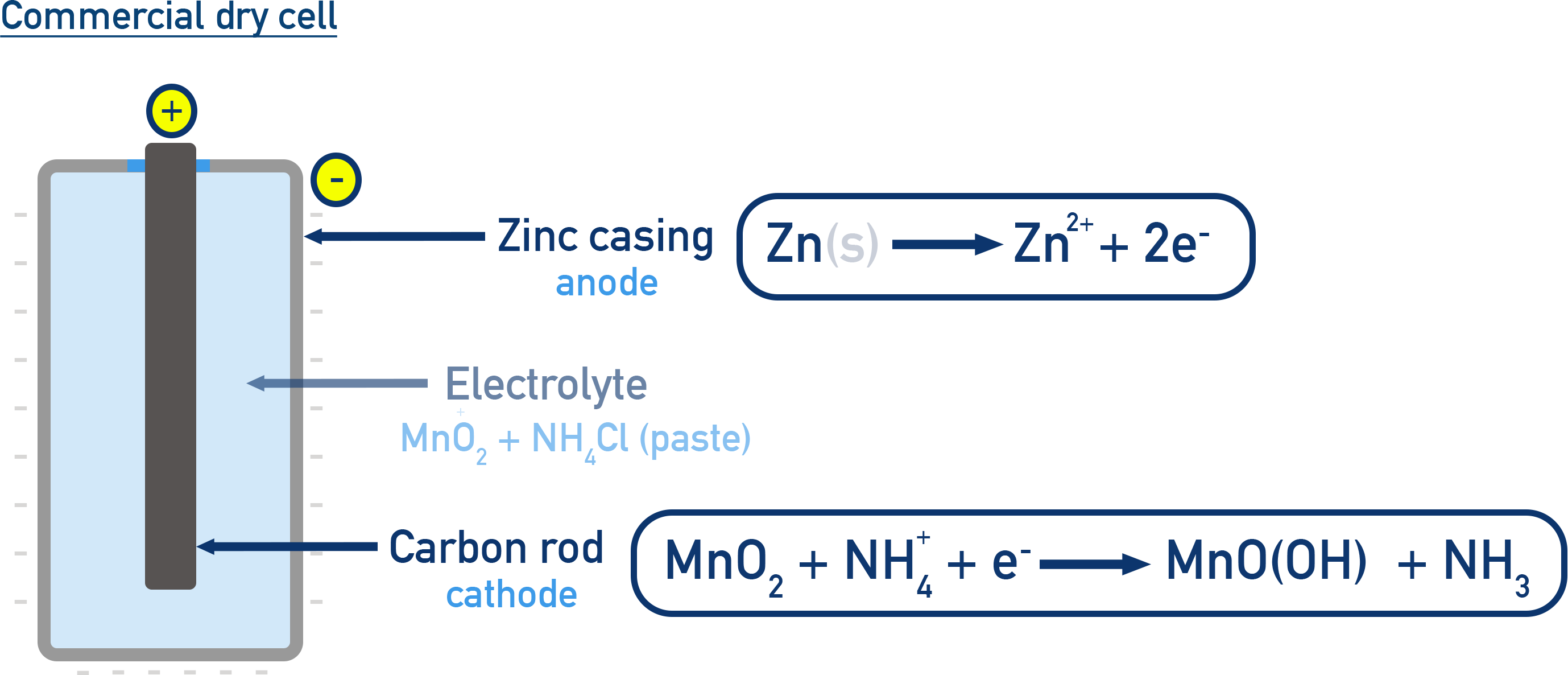
Construction:
- Zinc container: Acts as the anode.
- A paste of NH4Cl and ZnCl2: Acts as the electrolyte.
- A carbon rod surrounded by manganese dioxide (MnO2) and carbon powder: Cathode.
Reactions:
- Anode: Zn → Zn2+ + 2e−
- Cathode: MnO2 + NH4+ + e− → MnO(OH) + NH3
Features:
- Inexpensive.
- Portable.
- Cannot be recharged.
- Used in flashlights, clocks, and remotes.
Mercury Cell (Used in hearing aids, watches)

- Electrolyte: Paste of KOH–ZnO
- Anode: Zinc amalgam — Zn(Hg) → Zn2+ + 2e−
- Cathode: HgO + H2O + 2e− → Hg(l) + 2OH−
- EMF: ~1.35 V (constant throughout use)
Secondary Batteries
Secondary (or rechargeable) cells are electrochemical cells in which the redox reactions are reversible.
The cell can be recharged by passing an electric current in the opposite direction to when the cell is in normal use. Common examples include lead–acid car batteries and lithium-ion batteries (such as used in mobile phones and laptops).
Discharge vs. Charging Reactions
- Discharge: works like a voltaic cell – spontaneous redox reaction occurs and electron flow from the anode to the cathode produces a current.
- Charging: works like an electrolytic cell – a non-spontaneous redox reaction (the opposite direction to the discharge reaction) is forced to happen by the use of external energy.
To work out a charging reaction:
- Reverse the discharge half-equations
- Switch anode and cathode reactions
Example: Lead–Acid Battery
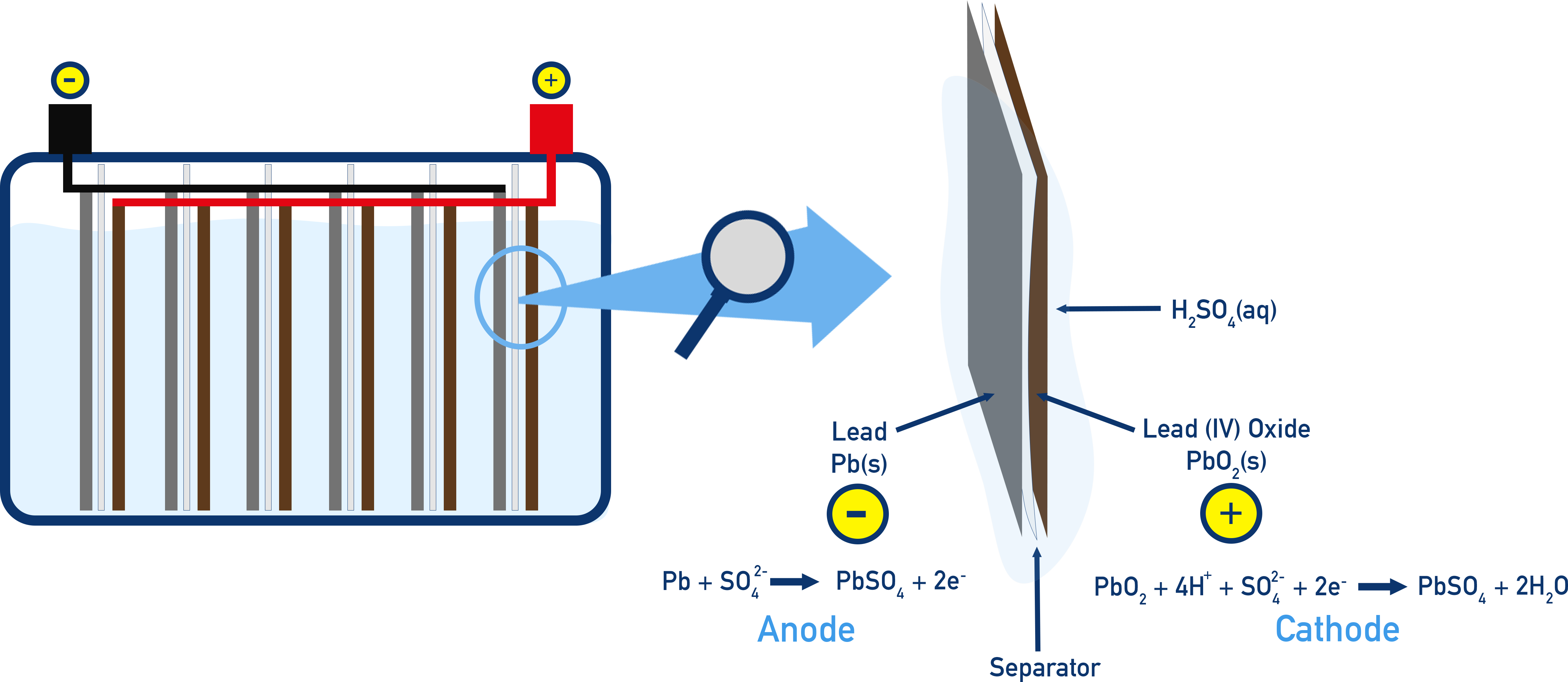
Discharge reactions:
- Anode (oxidation): Pb(s) + SO42−(aq) → PbSO4(s) + 2e−
- Cathode (reduction): PbO2(s) + 4H+(aq) + SO42−(aq) + 2e− → PbSO4(s) + 2H2O(l)
Charging reactions:
Reverse both reactions using an external voltage source.
Nickel–Cadmium (Ni–Cd) Battery
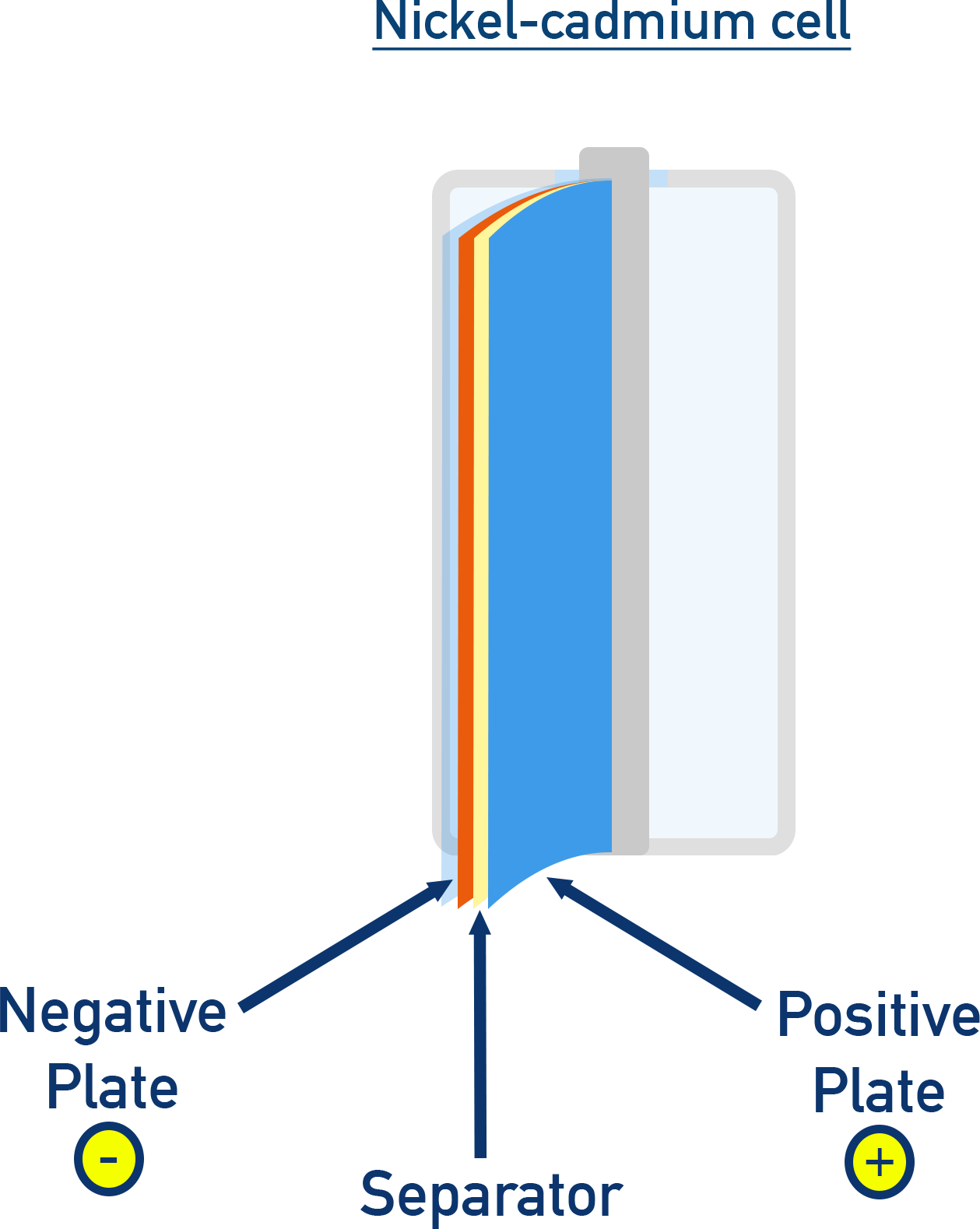
- Anode: Cadmium (Cd)
- Cathode: Nickel(III) oxide (NiO(OH))
- Electrolyte: KOH
- Discharge reaction: Cd + 2NiO(OH) + 2H2O → Cd(OH)2 + 2Ni(OH)2
- Rechargeable, but more expensive than lead–acid.
- Used in: Cameras, mobile devices (older models).
Summary
- Batteries convert chemical energy to electrical energy using redox reactions.
- Primary cells are single use and not rechargeable.
- Secondary cells are rechargeable by reversing the discharge reactions.
- Typical systems include dry cell and mercury cell for primary and lead–acid and Ni–Cd for secondary.
Fuel Cells
Quick Notes
- Fuel Cells are devices that convert the chemical energy of a fuel directly into electrical energy through redox reactions.
- In a hydrogen-oxygen fuel cell, H2 is oxidized at the anode, and O2 is reduced at the cathode.
- Overall cell reaction:
- 2H2(g) + O2(g) → 2H2O(l)
- ΔG < 0 = spontaneous, highly efficient.
- Advantages: Continuous power generation, clean byproduct (H2O), high efficiency.
- Limitation: Storage and supply of H2 and O2 gases is a challenge.
Full Notes
Introduction to Fuel Cells
Fuel cells are electrochemical cells that convert the chemical energy of a fuel directly into electrical energy.
Unlike conventional cells that store reactants, fuel cells receive a continuous supply of fuel and oxidant from external sources, enabling sustained operation as long as these are provided.
These cells operate similarly to galvanic cells, but instead of using solid electrodes and internal electrolytes alone, they depend on external sources of reactants. The most well-known example is the hydrogen-oxygen fuel cell, often used in space programs and considered for future sustainable energy technologies.
Working of a Hydrogen–Oxygen Fuel Cell
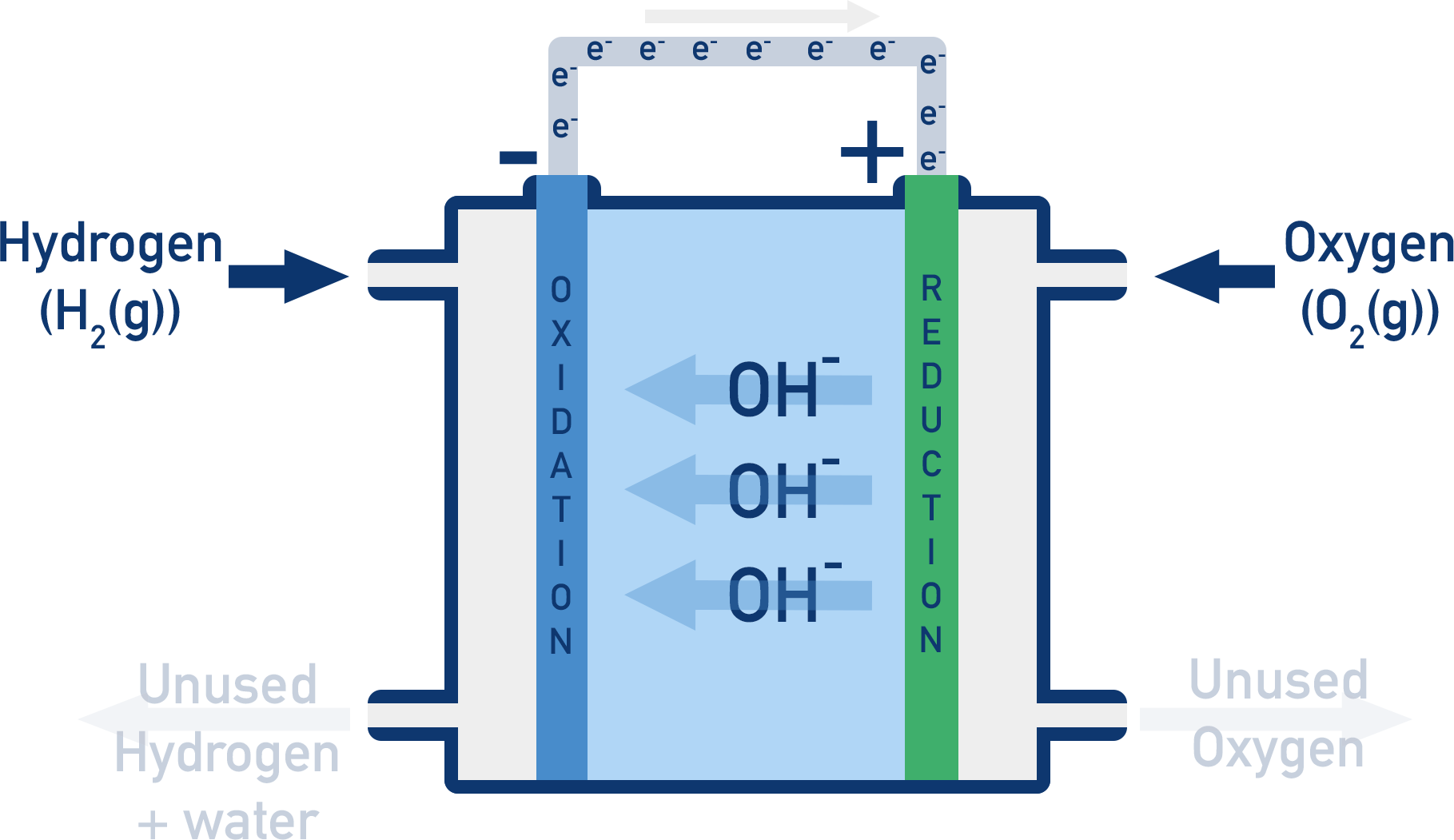
- Electrolyte: Concentrated aqueous potassium hydroxide (KOH) solution.
- Electrodes: Porous carbon electrodes impregnated with platinum or silver as catalysts.
- Fuel: Hydrogen gas is bubbled into the anode side.
- Oxidant: Oxygen gas is bubbled into the cathode side.
- The cell operates at about 523–573 K and 50 atm pressure.
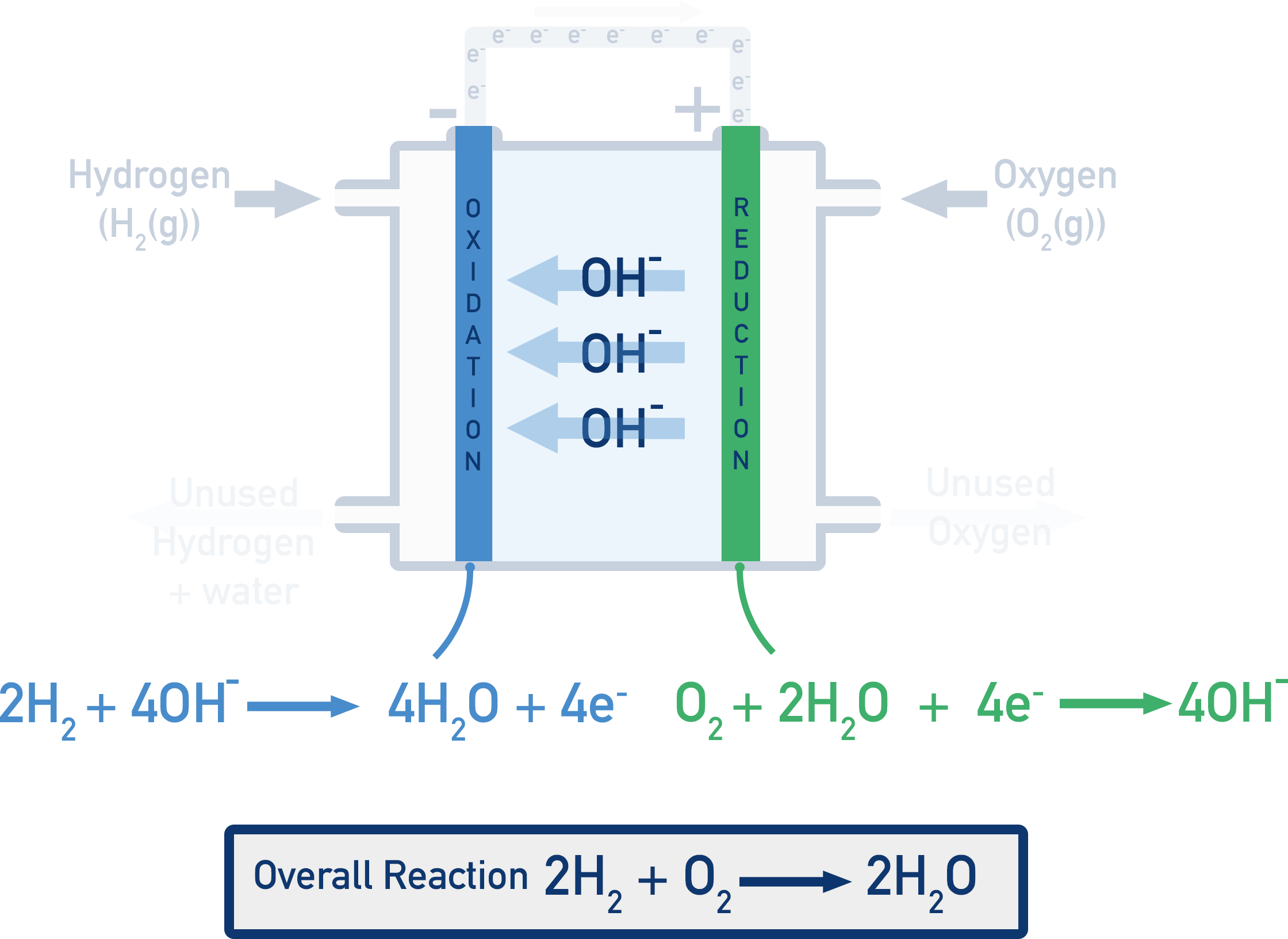
- Anode Reaction (Oxidation): H2(g) + 2OH−(aq) → 2H2O(l) + 2e−
- Cathode Reaction (Reduction): ½O2(g) + H2O(l) + 2e− → 2OH−(aq)
- Overall Reaction: 2H2(g) + O2(g) → 2H2O(l)
This reaction is highly exothermic and results in a spontaneous redox process, with electrons flowing through the external circuit to generate electricity.
Features and Advantages
- Efficiency: Much higher than combustion engines, since no thermal step is involved.
- Byproducts: Water is the only byproduct, making it environmentally friendly.
- Silent Operation: No moving parts, so operation is quiet.
- Continuous Operation: Works as long as fuel and oxidant are supplied.
Limitations
- Hydrogen storage and distribution remain significant technical challenges.
- The catalysts (e.g., platinum) are expensive.
- System design and scaling for widespread use are complex.
Applications
- Spacecraft: NASA has used H2–O2 fuel cells to power onboard systems.
- Automotive Industry: Research into hydrogen fuel cell vehicles is ongoing.
- Backup Power Systems: Reliable electricity source in critical facilities.
Summary
- Fuel cells convert chemical energy directly into electrical energy using continuous supplies of fuel and oxidant.
- Hydrogen–oxygen cells use porous carbon electrodes with Pt/Ag and aqueous KOH.
- Anode oxidizes H2 and cathode reduces O2 giving water as the only byproduct.
- They are efficient and clean but face challenges with gas storage and catalyst cost.
Corrosion
Quick Notes
- Corrosion is the gradual destruction of metals by chemical or electrochemical reaction with their environment.
Example: Rusting of iron is the most common form. - Corrosion typically occurs when a metal reacts with air, moisture, or acids.
- Rust is a hydrated form of ferric oxide: Fe₂O₃·xH₂O.
- Rusting is an electrochemical process involving anodic oxidation of Fe and cathodic reduction of O₂.
- At the anode: Fe → Fe²⁺ + 2e⁻
- At the cathode: O₂ + 4H⁺ + 4e⁻ → 2H₂O
- Overall reaction (in acidic medium): 2Fe + O₂ + 4H⁺ → 2Fe²⁺ + 2H₂O
- Fe²⁺ gets further oxidised to Fe³⁺ and forms rust.
- Moisture (H₂O), O₂, CO₂, and acidic conditions accelerate corrosion.
- Corrosion is prevented by:
- Barrier protection (painting, greasing)
- Alloying (e.g., stainless steel)
- Galvanisation (coating with zinc)
- Cathodic protection
Full Notes
Definition of Corrosion
Corrosion is a natural process where metals deteriorate due to chemical reactions with their environment. It typically involves the oxidation of metals by air (oxygen) and moisture (water), leading to the formation of oxides and other compounds.
A common example is the rusting of iron, which is the formation of iron oxides (like Fe2O3·xH2O). Other forms include the tarnishing of silver and the green coating on copper.
Chemical Basis of Corrosion
Corrosion can be considered an electrochemical process where the metal loses electrons and gets oxidised. It involves the following:
- Anode (oxidation site): The metal atoms lose electrons and form metal ions.
For iron: Fe(s) → Fe2+(aq) + 2e− - Cathode (reduction site): Oxygen is reduced by gaining electrons in the presence of hydrogen ions.
Reaction: O2(g) + 4H+(aq) + 4e− → 2H2O(l)
Overall redox reaction: 2Fe(s) + O2(g) + 4H+(aq) → 2Fe2+(aq) + 2H2O(l)
Standard electrode potentials: E°(Fe2+/Fe) = −0.44 V, E°(O2/H2O) = +1.23 V, E°(cell) = 1.67 V
Mechanism of Rust Formation
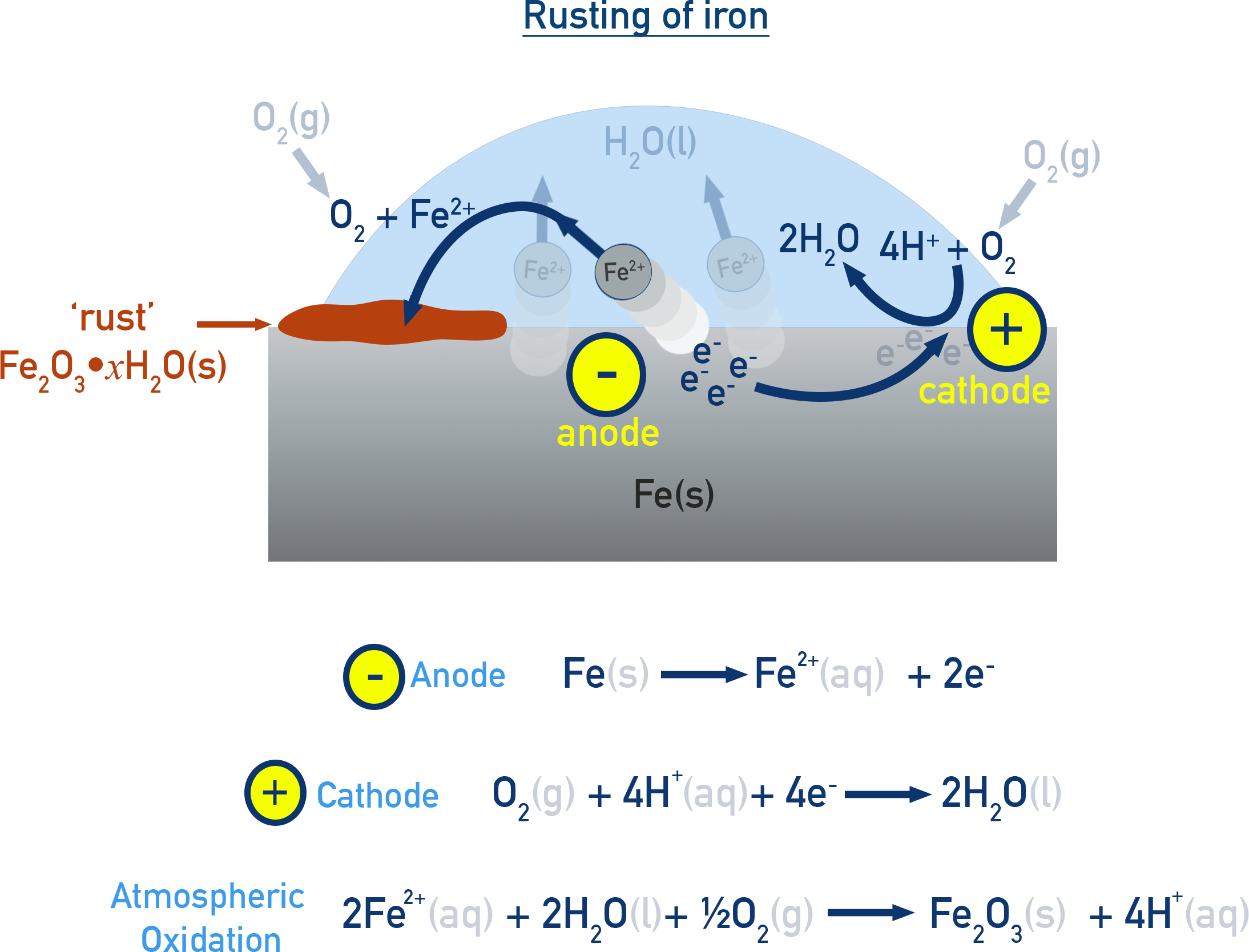
At a localised anode on the iron surface: Fe(s) → Fe2+ + 2e−
Electrons flow to the cathodic site, often another area of the same surface.
At the cathode, oxygen reacts with H+ (from H2CO3 or other acids in water) and the electrons: O2 + 4H+ + 4e− → 2H2O
The Fe2+ ions formed at the anode are further oxidised to Fe3+ by atmospheric oxygen, forming rust, mainly hydrated iron(III) oxide: Fe2O3·xH2O.
Prevention of Corrosion
Corrosion causes severe economic losses and structural damage, so its prevention is essential. Methods include:
- Barrier Protection: Coating the metal surface with paint, oil, grease, or chemicals to prevent exposure to air and moisture.
- Alloying: Using metals that do not corrode easily (e.g., stainless steel).
- Sacrificial Protection: Attaching a more reactive metal (like zinc or magnesium) that corrodes in place of the protected metal.
- Electrochemical Protection: Using an external power source or a sacrificial anode to force the protected metal to stay in its reduced state.
Summary
- Corrosion is an electrochemical process where metals oxidise in their environment.
- Rusting of iron involves anodic Fe oxidation and cathodic O2 reduction.
- Acidic conditions and moisture accelerate rusting of iron.
- Protection methods include barrier coatings, alloying, galvanisation, and cathodic protection.
No comments:
Post a Comment